




Proof of Work (PoW)
Proof of work secures a blockchain by making block production require real, costly computation. The network trusts the history with the most work behind it, so rewriting the past is prohibitively expensive.
The idea is older than cryptocurrency. It was first proposed in 1993 as a way to make junk email expensive to send. In 1997 a system called Hashcash used the same idea for email. Bitcoin, launched in 2009, applied it to a public ledger.
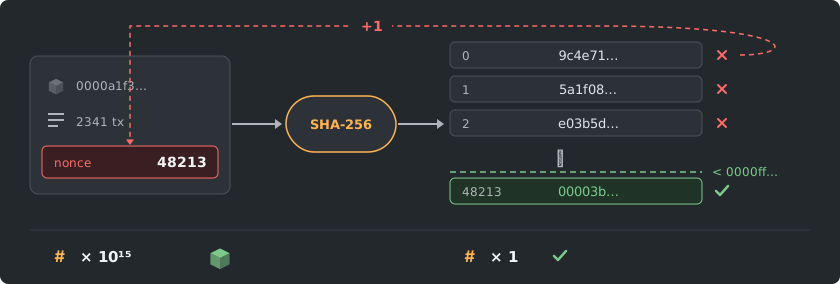
Here is how it works. A miner gathers transactions into a candidate block and adds a number that can be changed, called a nonce. It hashes the block, which produces a number that looks random. If that number is below the network's target, the block is valid. If not, the miner changes the nonce and tries again, billions of times a second.
Finding a valid hash is hard, but checking one is instant. Anyone can hash the block once and confirm it meets the target. That is what lets thousands of computers agree on the chain without trusting each other.
It also makes the past expensive to change. To rewrite an old block, an attacker would have to redo its work and the work of every block after it, faster than the rest of the network. The deeper a transaction is buried, the safer it is.
This is what miners do: spend computing power to earn the right to add blocks and collect the reward. Each coin chooses its own algorithm, which decides whether CPUs, GPUs or ASICs do the work best. Some newer designs try to make the work itself useful, such as real matrix maths proven with a zero-knowledge proof.
A common misconception is that the work is solving a clever problem. It is closer to a lottery: each hash is a ticket, and more hashrate buys more tickets. Proof of stake is the main alternative. It secures the chain with locked coins instead of computation, and has no mining.