





What is hashrate?
What hashrate measures, the units it is shown in, why your miner and the pool report different numbers, and what lowers your effective rate.
What is hashrate?
Hashrate is how much mining work your hardware does per second. It is the most important performance number for a miner.
More work means more chances to contribute to a block. So a higher hashrate earns a larger share of the rewards.
What units is hashrate shown in?
Hashrate is counted per second and scales up with prefixes:
- kilo (K)
- mega (M)
- giga (G)
- tera (T), and so on.
Different algorithms report in different base units. Whatever the unit, a bigger number means more work per second.
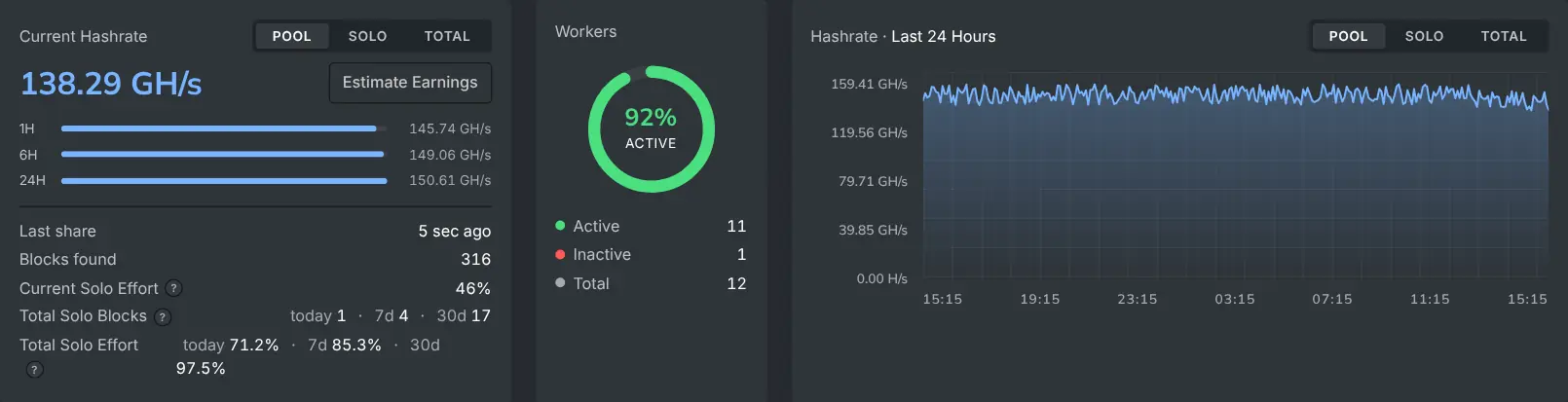
The pool shows your hashrate next to the pool and network totals, for context.
Why do my miner and the pool show different numbers?
Your miner console reports its raw local speed. The pool can only estimate your hashrate from the shares it receives over a time window.
They measure different things, so they never match exactly. Over short windows, the pool figure also wobbles with luck. Compare against the 24-hour average, not the minute-by-minute view.
What lowers your effective hashrate?
Your effective hashrate is the speed the pool credits you with. Stale and rejected shares do not count toward it. So any of these pull it below your card's raw speed:
- High latency.
- An unstable overclock.
- A flaky connection.
Keep them low by choosing a close server and a stable tune. That keeps your effective hashrate close to your real one.