








What is crypto mining?
A plain-English guide to how mining secures a blockchain, why it pays you in coins, where new coins come from, and how Qubitcoin's useful work fits in.
What is crypto mining, in one sentence?
Crypto mining is using a computer to do the work that keeps a blockchain running, and getting paid in that coin for it.
Your machine competes to produce the next valid block. When the network accepts a block, its reward goes to whoever produced it.
Why is the mining work needed?
A blockchain has no central server deciding which transactions are real. Instead, producing a block requires provable computational work. That makes rewriting history far too expensive to try.
This is what "proof of work" means. The chain trusts the version of history that the most work stands behind.
Where do mined coins come from?
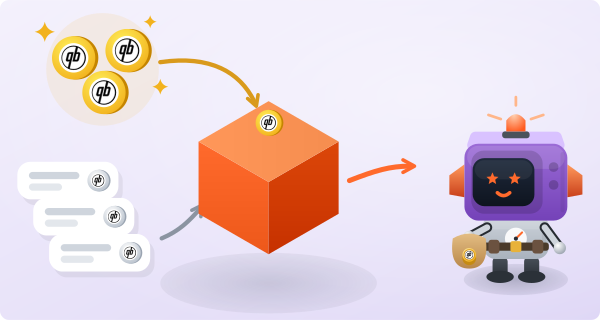
Each block carries a reward made of two parts.
- Newly issued coins.
- The fees of the transactions the block includes.
That reward is the incentive to mine. It is also how new coins enter circulation.
On Qubitcoin, the reward halves every 210,000 blocks, about every four years, the same schedule as Bitcoin.
What makes Qubitcoin different: qhash
Qubitcoin is a proof-of-work coin built on Bitcoin Core, and it keeps Bitcoin's supply rules.
Its hash, qhash, runs a small simulated quantum circuit between two SHA-256 steps. That is why graphics cards mine it rather than Bitcoin's ASICs.
You mine it with a graphics card and earn QTC.