







Shares, difficulty and effort explained
The three numbers behind every mining dashboard: what a share proves, what share difficulty tunes, what effort says about luck, and what an orphan is.
What is a share?
A share is a small, checkable piece of mining work that your rig sends to the pool. Shares are how the pool measures each miner's contribution. Your reward is calculated from them.
On Qubitcoin, every share is a qhash result that the pool verifies before counting it.
What does share difficulty do?
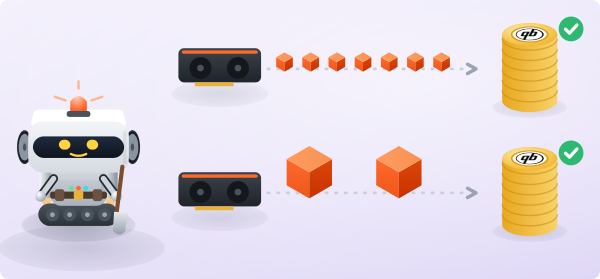
The pool tunes a share difficulty for each rig. It keeps every rig, small or large, sending shares at a steady, sensible pace.
- Higher share difficulty means fewer but heavier shares.
- Lower share difficulty means more but lighter shares.
Either way, the total work is the same. So share difficulty does not change your earnings, only the rhythm of your shares.
What does effort tell you?
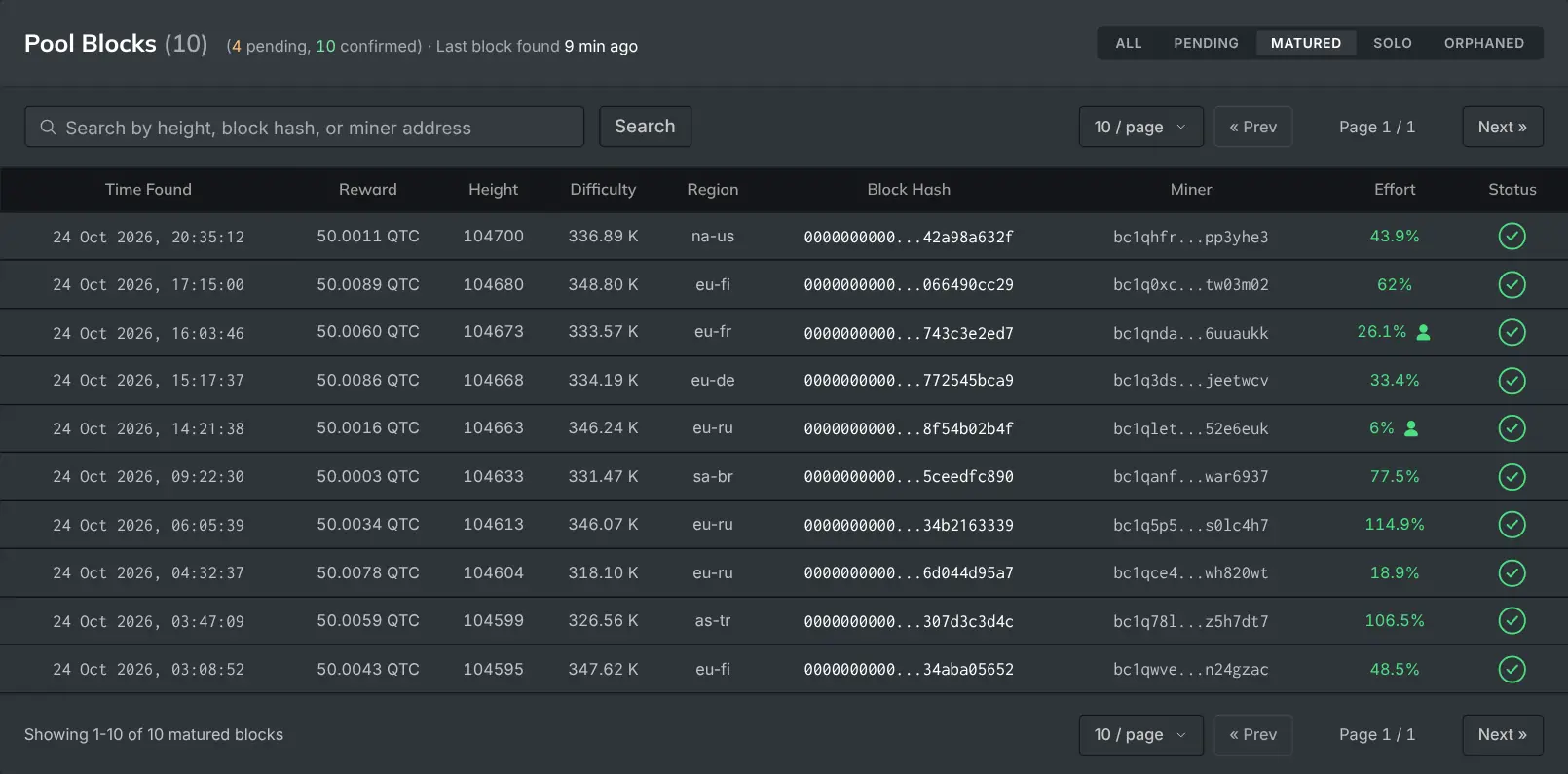
Effort is a luck meter. It compares the work spent finding a block with the work the network difficulty says it should take.
- 100% means the block took exactly the expected work.
- Under 100% means the block came early. That is lucky.
- Over 100% means the block came late. That is unlucky.
Single blocks swing widely. Over many blocks, effort averages toward 100%. It is a fairness meter, not a performance dial you can turn.
What is an orphaned block?
Sometimes two blocks are found at nearly the same moment, and the network keeps only one. The losing block is orphaned and pays nothing.
This happens on every blockchain, to every pool. It is part of the same variance that effort measures.