








What is a mining pool?
What a mining pool does, why miners join one instead of mining alone, what it costs, and how it turns your shares into steady payouts.
What is a mining pool?
A mining pool is a group of miners who combine their hashrate to find blocks more often. Hashrate is the speed at which a rig does mining work. When the pool finds a block, the reward is split by the work each miner contributed.
Why mining alone is feast or famine
On your own, you only earn when your rig finds a block itself. For most miners that could mean weeks or months between rewards. Nothing comes in between.
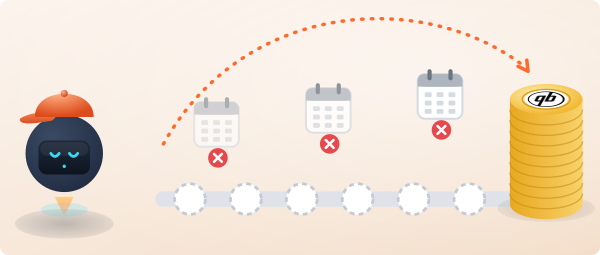
The long-run average might be fine. But the wait is brutal and unpredictable.
How a pool shares the luck
The pool finds blocks far more often than any one member could. When it does, the reward is split across everyone. Each miner's slice matches the work they contributed.
You trade the rare big win for many small, steady payouts. Over the long run, both are worth the same.
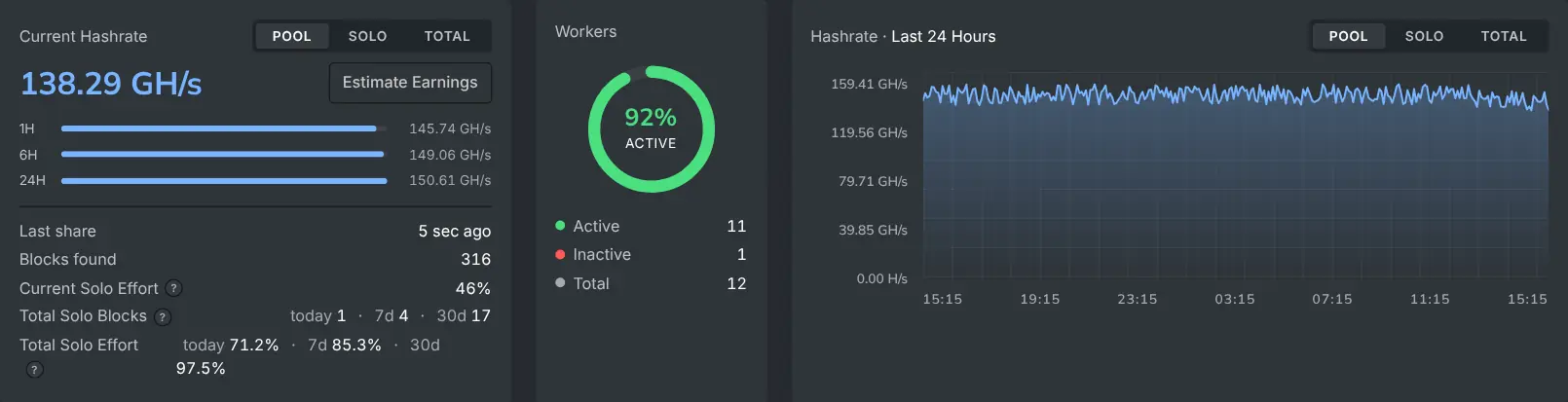
What the pool does for you
The pool handles the hard parts of mining:
- It runs the full nodes, the computers that keep a copy of the blockchain.
- It builds the work your miner solves.
- It verifies every share. A share is a piece of work that proves your rig is mining.
- It tracks each miner's contribution.
- It sends payouts automatically.
You just point a miner at it with your wallet address. This pool has no account. Your address is your identity and your payout destination.
What a pool costs
Pools charge a small fee on rewards for all of that. Here there are two flat fees:
- one on the blocks the pool shares out;
- one on the blocks a solo miner keeps. A solo miner keeps the whole block they find.
Both fees are shown live on the pool statistics. They are deducted automatically, and there are no other charges.
In exchange you get steady income and live stats. You also never have to run the infrastructure yourself.