








Why am I not paid for every block?
Two blocks found seconds apart can pay you nothing. Learn why that happens under PROP, why it evens out, and how PPLNS and PPS+ pay the same work.
The short answer
You are paid for every block whose round holds your shares. A block pays you nothing when its round held none of your shares. That happens most often when the pool finds two blocks a few seconds apart.
Nothing is skipped. Every share you send is paid once, by the block that ends the round it landed in.
How does a PROP round work?
Under PROP (proportional), the pool's work is cut into rounds.
- A round starts the moment the pool finds a block.
- It ends the moment the pool finds the next one.
- The block that ends a round is shared out, after the pool fee, among the miners who sent shares in that round.
- Each miner gets a part in proportion to the work their shares proved.
- Then the count starts again from zero.
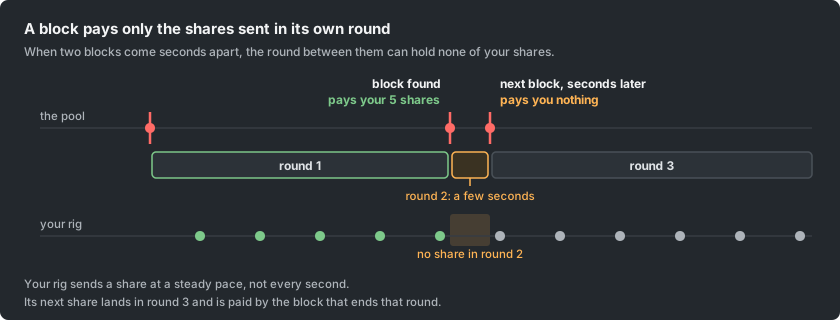
So a block pays only the shares sent in its own round. A share sent one second before a block is paid by that block. A share sent one second after it belongs to the next round, and the next block pays it.
Why can a block found seconds later pay you nothing?
A pool sometimes finds two blocks a few seconds apart. It can happen on any coin, most often on a coin with fast blocks. The round between those two blocks lasts only those few seconds.
Your rig does not send a share every second. Your share difficulty is set so each rig sends shares at a steady pace, often many seconds apart.
If your rig sent no share in that short window, you have no shares in that round. So that block has nothing to pay you. The miners whose shares landed in those seconds share it between them.
Why does it still even out?
A short round holds very few shares in total, so each share in it is worth a lot. A long round holds many shares, so each one is worth less.
Your shares land in rounds in proportion to how long each round lasts, just like everyone else's. Over many blocks, the short rounds you miss and the short rounds you catch cancel out. You earn your hashrate's share of everything the pool finds.
Do you need a share in every round?
No. Your rig does not need to send shares faster than the pool finds blocks.
A short round rarely holds one of your shares. When it does, that share is a big part of a very small round. So that block pays you a big part of its reward.
The blocks that pay you nothing and the blocks that pay you a big part balance each other out. On average, every block pays you your hashrate's share of it, however long its round lasted.
A slow share pace only makes your payouts more uneven from block to block. It does not lower their total.
A reward from every block would not mean earning more. Your shares would be spread over more blocks, with a smaller reward from each. Your total would stay the same.
Judge a pool by what reaches your balance over days, not by how many blocks you appear in.
How do PPLNS and PPS+ pay the same work?
The other two schemes pay the same work in a different rhythm. At the same fee, none of them pays more for the same hashrate over time. They differ in when the money arrives and in who carries the luck.
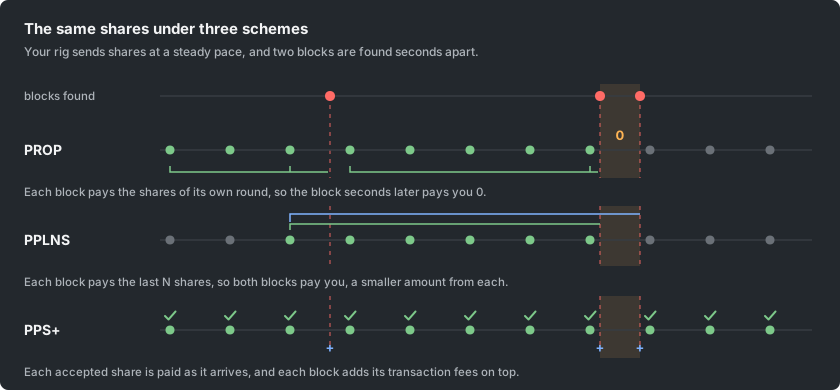
PPLNS (pay per last N shares) has no rounds. When a block is found, it pays the last N shares sent before it, however many blocks ago they were sent.
Two blocks found seconds apart look back over almost the same shares. So you appear in both, with a smaller amount from each.
PPS+ (pay per share plus) does not wait for blocks. Every share the pool accepts is paid a fixed amount as it arrives. So two blocks found seconds apart change nothing about what a share earns.
The plus is the transaction fees of each block the pool finds. They are shared out on top when that block matures. The pool carries the luck instead of you. That is why pay-per-share schemes usually charge a higher fee.
| Scheme | A share is paid | Two blocks seconds apart | Who carries the luck |
|---|---|---|---|
| PROP | Once, by the block that ends its round | The second pays only the shares sent in between | The miners |
| PPLNS | By every block found while it is among the last N | Both pay almost the same shares | The miners |
| PPS+ | Once, a fixed amount when it is accepted | No change to what a share earns | The pool |