








Proof of work vs proof of stake
How proof of work and proof of stake secure a blockchain in different ways, what each one costs, and why only proof-of-work coins can be mined.
What is the difference between proof of work and proof of stake?
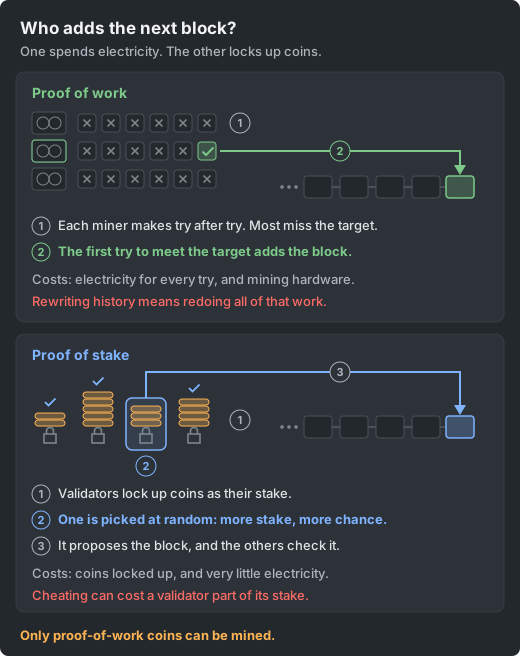
Both decide who adds the next block to a blockchain. Proof of work makes miners spend computing power. Proof of stake makes validators put their own coins at risk. Only proof of work involves mining.
Every blockchain needs a way to agree on whose version of history is real, with no central authority. These two are the dominant answers, and they secure the chain very differently.
| Aspect | Proof of work | Proof of stake |
|---|---|---|
| Who adds blocks | Miners | Validators |
| What it costs | Electricity and mining hardware | Coins locked up as stake |
| Security rests on | Work spent | Locked capital |
| Energy use | Much more | Far less |
| What cheating costs | Redoing all the work | Part of the stake |
| To take part you need | Hardware | Coins |
How does proof of work secure a chain?
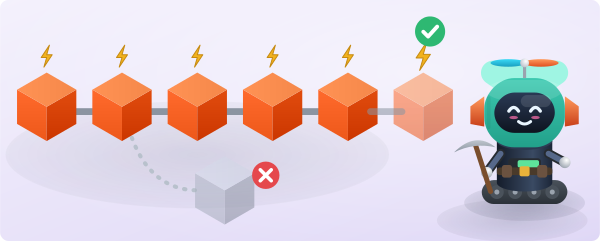
In proof of work, making a block takes real computation. The chain trusts the history with the most work behind it.
Rewriting the past would mean redoing all that work. That is far too expensive to be worth trying.
This is what miners do. They spend computing power to earn the right to add blocks and collect the reward.
How does proof of stake secure a chain?
Proof of stake has no mining. Participants lock up coins, called staking, for the right to propose and check blocks. Misbehaviour can cost them their stake.
It uses far less energy. But its security rests on locked capital rather than spent work. You need coins to take part, not hardware.
Where does Qubitcoin fit?
Qubitcoin is a proof-of-work coin. That is why you can mine it with a GPU.
Its twist is qhash. Between two SHA-256 steps, its hash runs a small simulated quantum circuit.
That circuit step is parallel maths a graphics card runs well, and a Bitcoin ASIC cannot run it.