








Electricity prices by country, and what they do to a rig
Household power costs from about 5 to over 40 cents a kWh. Learn why one card profits in one country and loses in another, and how to find your real price.
Why does the electricity price decide profit?
The same card can earn money in one home and lose it in another. Two people can run it on the same coin at the same difficulty. Nothing about the hardware differs. The electricity bill does.
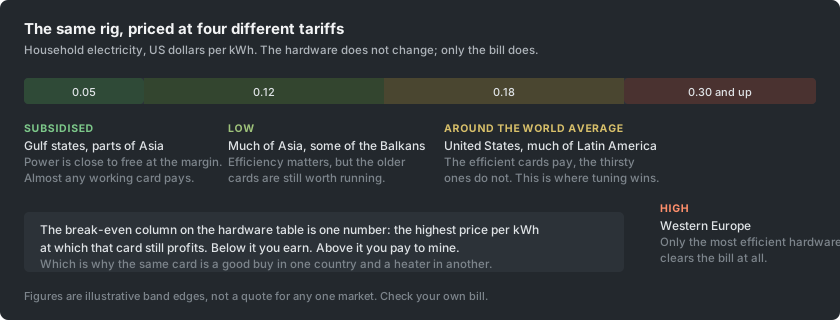
Household electricity worldwide averages close to 18 US cents per kWh (kilowatt-hour). That average is the least useful number here. Subsidised markets sell power at around 5 cents. Several Western European markets sit above 30 cents.
That is a factor of 6 or more on the one cost that never stops.
What does power cost in different countries?
These are reference points, not a quote for your address, and every one of them moves. Take the shape from them. Then get your own number from your own bill.
- United States: the residential average is roughly 18 cents per kWh in 2026. Inside the country the spread is nearly 4 to 1. It runs from around 11 cents in North Dakota and Utah to around 40 cents in Hawaii.
- European Union: the household average was 28.96 euro cents per kWh in the second half of 2025. Ireland was highest at 40.42 and Hungary lowest at 10.82. Belgium, Germany and Denmark all sat above 30.
- Asia: the region averages far lower, around 9 or 10 cents. Gulf states with subsidised tariffs are lower again.
- Change within one year: prices can move violently. In the year to the second half of 2025, Romania rose by more than half. Cyprus, France and Denmark all fell by more than a tenth.
Take that last point seriously. A rig that was comfortably profitable when you bought it can stop being profitable. A tariff change you had no part in is enough. That has happened to whole countries of miners at once.
Why is the figure on your bill the wrong one?
The usual mistake is typing the figure from the bottom of your bill into a calculator. That figure averages things that are charged differently.
What a rig costs you is the marginal price. That is what the next kilowatt-hour costs, not what the last thousand averaged.
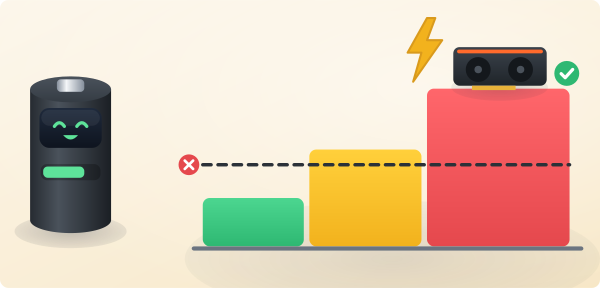
- Block or tiered tariffs. Many countries charge a low rate for the first slice of monthly use and a much higher rate after it. A rig running full time keeps you in the top block. So the rig is charged the top rate, even when your average looks moderate.
- Time of use. Where day and night rates differ, a rig running 24 hours pays the blended rate. It does not pay the cheap night rate people quote.
- Standing charges. This fixed monthly fee does not change with the rig. Including it in your per kWh figure overstates what mining costs you.
- Taxes and levies. In several markets these are a large part of the price. They are what separates otherwise similar countries.
- Demand or capacity charges. These are mostly a commercial concern. Some residential tariffs also price your peak draw, and a rig raises your baseline permanently.
How do you find your real price?
You need one bill and a subtraction.
- Take the total charged for energy.
- Remove the fixed standing charges.
- Divide by the units consumed. That gives your real average.
- Check whether you are on a tiered scheme. If you are, use the rate of the highest block you reach, not the average. That is the rate the rig is charged at.
A separate meter for the rigs makes this much easier. It also helps at tax time. An electricity cost set against mining income is far easier to defend when it was measured, not estimated.
Then enter that figure in the electricity box above the hardware table. It defaults to a United States style figure, because a default has to be something. It is the single input that changes the ranking most.
What does the break-even column tell you?
The hardware table shows a break-even figure for each card. It is the highest electricity price at which that card still earns more than it costs to run. Below that price you profit. Above it you pay to mine.
Sorting by break-even shows something the profit column does not. Profit says what a card earns at your price today. Break-even says how much room the card has before a tariff rise or a difficulty rise takes it under.
On hardware you will own for years, that headroom is worth more than a few cents a day.
What can you do about an expensive tariff?
No amount of tuning turns a bad tariff into a good one. Tuning moves the line, and near the line that is enough to matter.
Undervolting means running a card at a lower voltage or power limit. It is the strongest lever most people have, because it cuts power draw more than it cuts hashrate. On an expensive tariff, the efficient setting is often the difference between earning and not.
The undervolting article shows how to find that setting without guessing.
Heat is the lever people underrate. Heat you would otherwise pay to produce is not waste in a cold month. A rig in a room you heat anyway has different economics from the same rig in a room you cool.