




FPPS
FPPS stands for full pay per share. It is pay per share extended to include transaction fees. The pool pays a fixed amount for every valid share, worked out from the block subsidy plus an average of recent fee income, whether or not it finds blocks.
Plain PPS pays only the subsidy, so the fee part of each block goes elsewhere. FPPS adds an expected fee value to every share. That value is usually an average of the fees in recent blocks across the network, so it rises when the network is busy and falls when it is quiet.
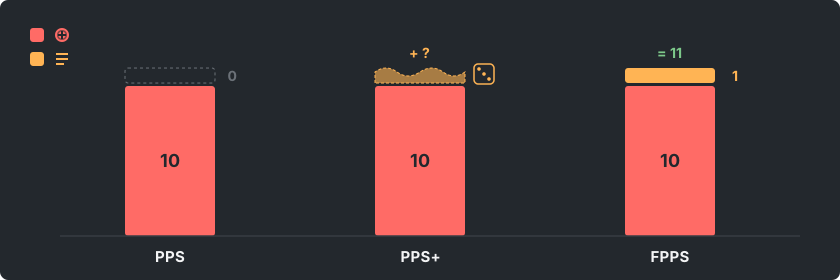
A worked example. Say a block pays 10 coins of subsidy and fees average 1 coin per block. A share worth one millionth of a block's work then pays one millionth of 11 coins, minus the pool fee. Under plain PPS the same share would pay one millionth of 10 coins.
It gives the miner the steadiest possible income and puts all the variance on the pool, which is why FPPS pools generally charge a higher fee than proportional ones. The pool pays for blocks it has not found yet and covers dry spells from its own reserves.
FPPS and PPS+ are often confused. Both pay the subsidy per share. FPPS pays the fee part per share too, from an average. PPS+ pays the fee part only from the blocks the pool actually finds, so that part still moves with the pool's luck.
FPPS matters most on coins where fees are a large part of the reward. Where fees are tiny, FPPS and plain PPS pay almost the same.
A common mistake is to compare pools on the fee alone. A higher fee under FPPS can still suit a miner who values steady income, and a lower fee under a proportional scheme can suit one who can wait out bad luck. Compare the scheme, the fee and your own need for predictable payouts together.